

Cart
0
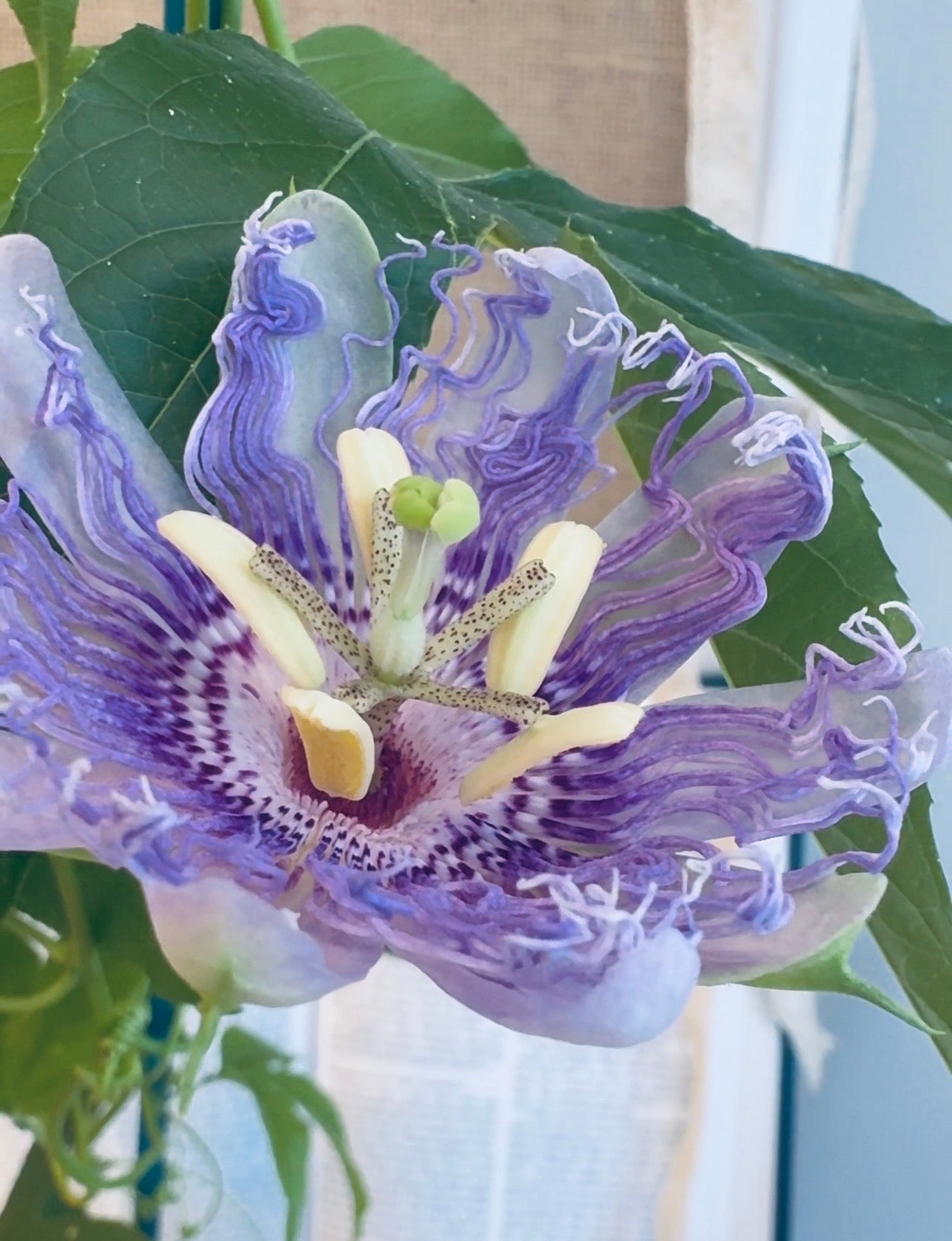
Of everything growing in my garden this year, the passionflower is the one that stops me every time I walk past it. It's a strange, wild-looking bloom — part flower, part crown — and once you know what it actually represents, it's hard to look at it as just a pretty vine.
A Climbing, Untamed Kind of Flower
Passionflower (Passiflora) isn't a plant that sits still. It's a climbing vine, sending out tendrils that grab onto anything nearby — a trellis, a fence, whatever will hold it — and pulling itself upward. Left alone, it sprawls. Trained onto something, it climbs beautifully. That in-between nature, wild but capable of real structure, is part of why I love growing it myself.
A Flower Named for the Crucifixion
The passionflower isn't named for romance. Spanish missionaries in the 16th century saw the flower's unusual structure and read it as a picture of the crucifixion — the Passion of Christ — and the name stuck.
Every part of the bloom was assigned a meaning:
- The fringed corona at the center represents the crown of thorns.
- The 10 petals and sepals stand for the 10 faithful apostles (excluding Judas and Peter).
- The three stigmas represent the three nails.
- The five stamens symbolize the five wounds.
- The curling tendrils are read as the whips used in the scourging.
- The blue and white coloring often seen in the bloom is tied to heaven and purity.
It's rare for a flower's entire anatomy to carry that much intentional meaning — most floral symbolism is about color or occasion. The passionflower's is built into its shape.
A Bloom That Lasts Only One Day
Here's the part that gets me every time: a passionflower blooms once, and that's it. It opens sometime in the midafternoon, full and dramatic like the one in the video above, and by evening it's already closing for good. There's no second day, no slow fade over a week on the vine. Just one afternoon.
That single-day window is part of why I wanted to preserve one in the first place. It's the same idea behind everything I make here — a bouquet only has to last one day too, and the keepsake is what carries it forward. The passionflower just makes that truth impossible to ignore, because with this one, I didn't even get a full day. I got an afternoon.
Why I Grow My Own
I grow passionflowers myself in Tennessee — a place that's meant so much to our family ever since my daughter Leah and I first started going there for the music and the art she loved. I'm not there full-time, but it's part of why this flower feels personal to me beyond its history.
There's also this: Leah works as an arborist, a climber. She goes up into trees the way this vine goes up a trellis — reaching, finding something to hold onto, and trusting it. Watching a passionflower climb reminds me of watching her work, and that's not something I take for granted.
A Tricky Flower to Preserve
As beautiful as it is, the passionflower is one of the harder blooms I've worked with. Between the one-day bloom window and how delicate the petals are, there's very little room for error — I had to catch it right as it opened and move fast, because once it closed that evening, the moment was gone.
The petals themselves are thin, and they don't forgive a rushed or overly harsh drying process — dry them too fast or with too much heat, and instead of holding their color, they turn translucent and lose the structure that makes the flower so striking in the first place.
Because of that, I went with a slower, gentler drying approach for this one instead of rushing it through silica gel, which can be hard on delicate petals over time. It takes longer and there's less room for error, but for a flower with this much detail, meaning, and such a short window to work with, it's worth the extra care.
This particular bloom is one I've been growing and watching closely, because it's headed into resin as a bigger, more special piece than most of what comes through my workshop. Between the symbolism, the climb, the family history, the single afternoon it gave me, and how hard it was to preserve without losing what makes it beautiful, it felt like it deserved more than just going into a bowl unnoticed.
The Finished Piece
Here is the pour, and the finished piece. The passionflower changed in the resin, its purple softening to silver, but every filament of that crown held.

Leah Lane Flowers hand-preserves real flowers in resin, turning wedding bouquets, garden blooms, and flowers that mean something into keepsakes that last. Every piece is one of a kind.
Sincerely, Your Flowers


